Academic Research,
Built for Browsing

A mobile-first interface for exploring academic theses and papers through short-form interaction patterns — applying familiar scroll-based UX to lower the entry barrier to research discovery.
TezTok Likes screen
TezTok Feed screen

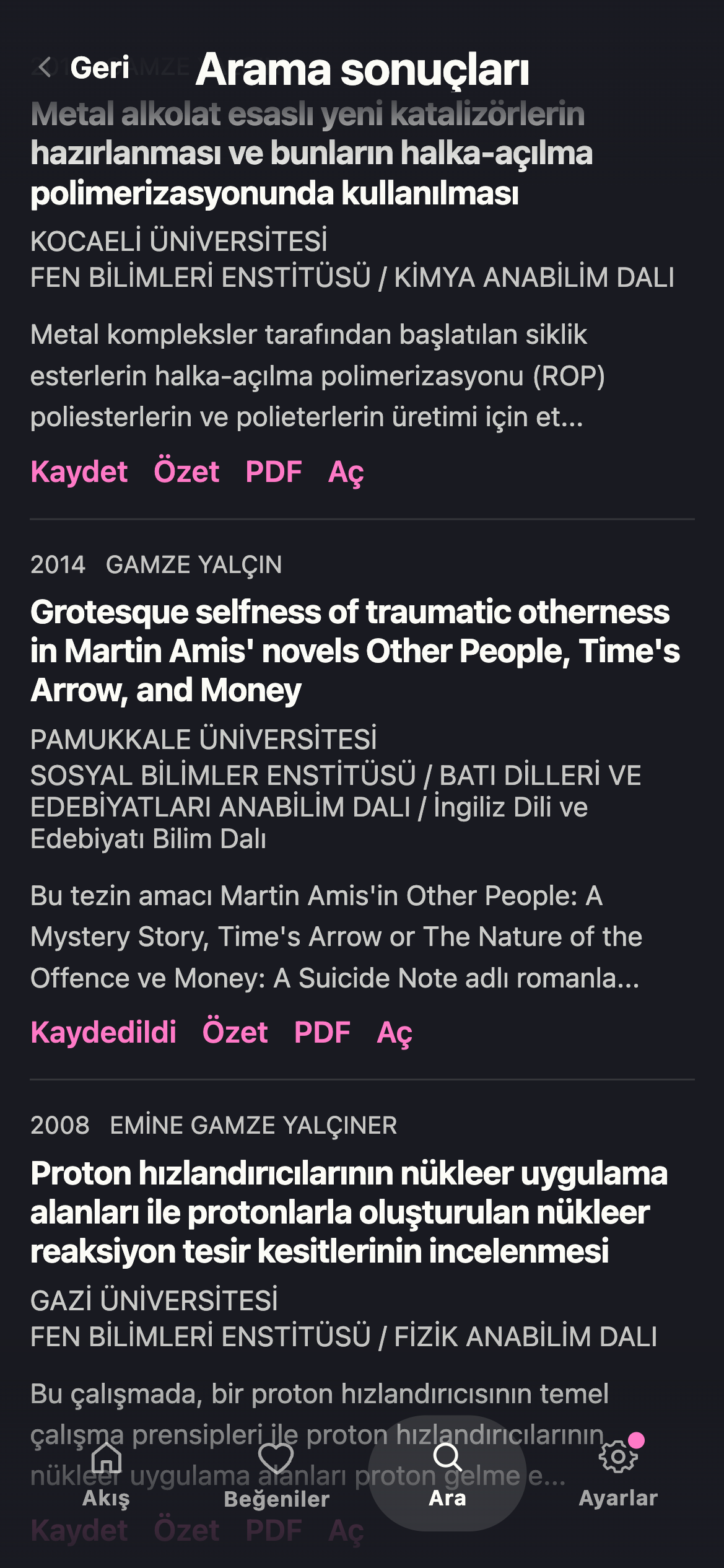
Research discovery
for the mobile era

An app that aggregates open-access academic content and presents it through a vertical snap-scroll feed — optimised for passive discovery rather than active search.

Vertical swipe feed

Snap-scroll through thesis cards. Each card surfaces title, authors, source, year, and a teaser of the abstract — full text one tap away.

Save & revisit

Heart any thesis to save it to your Likes library. Persisted locally — your reading list is always there when you come back.

Browse by topic

Filter by academic discipline — Engineering, Social Sciences, Medicine, CS, and more. Alphabetical jump bar makes switching fast.

Multi-source feed

Pulls from YÖKTez, OpenAlex, Semantic Scholar, CORE, and Crossref in one unified experience. Switch your preferred source from Settings.

YÖKTez OpenAlex CORE Semantic Scholar Crossref

Progressive disclosure
by design

Teaser first, abstract on demand, full paper one tap further. Depth is available without being required.

TezTok feed card 2
TezTok main feed

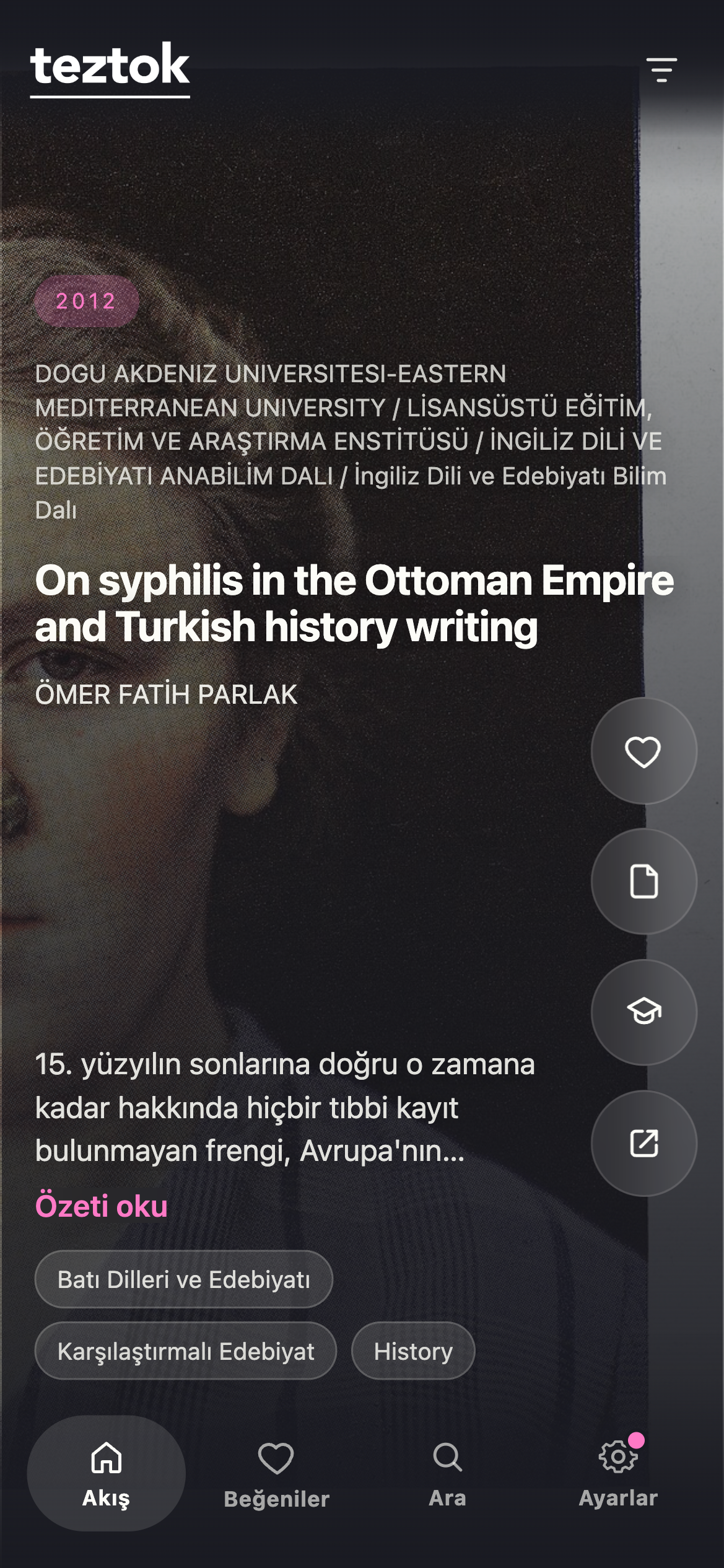
The vertical feed

Each full-screen card shows a thesis title, authors, source, publication year, a teaser of the abstract, and keyword chips. Swipe up to advance, swipe down to revisit.

  • Full-bleed contextual background image
  • Snap-scroll with haptic feedback
  • Open full paper in one tap
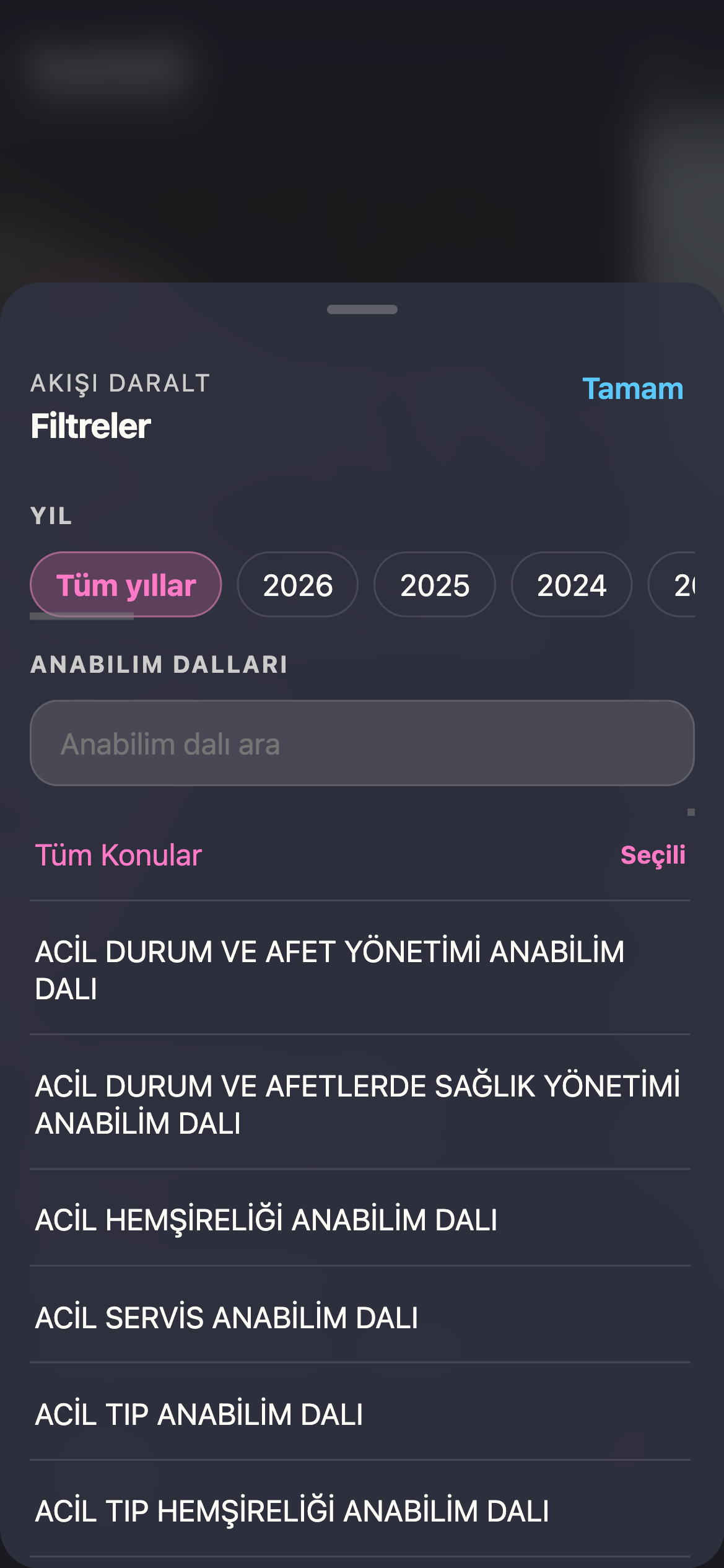
Topics picker

Browse by topic

Tap "All topics" to open the topic picker. Filter by academic discipline with an A–Z jump bar for fast navigation.

  • Dozens of academic disciplines
  • A–Z jump navigation
  • Filter within topics
Likes library

Your library

Every hearted paper lands in the Likes tab — title, authors, year, and source. Tap to remove or dive back in with a single press.

  • Persisted in local storage
  • One-tap remove
  • Available without re-fetching
Full paper view
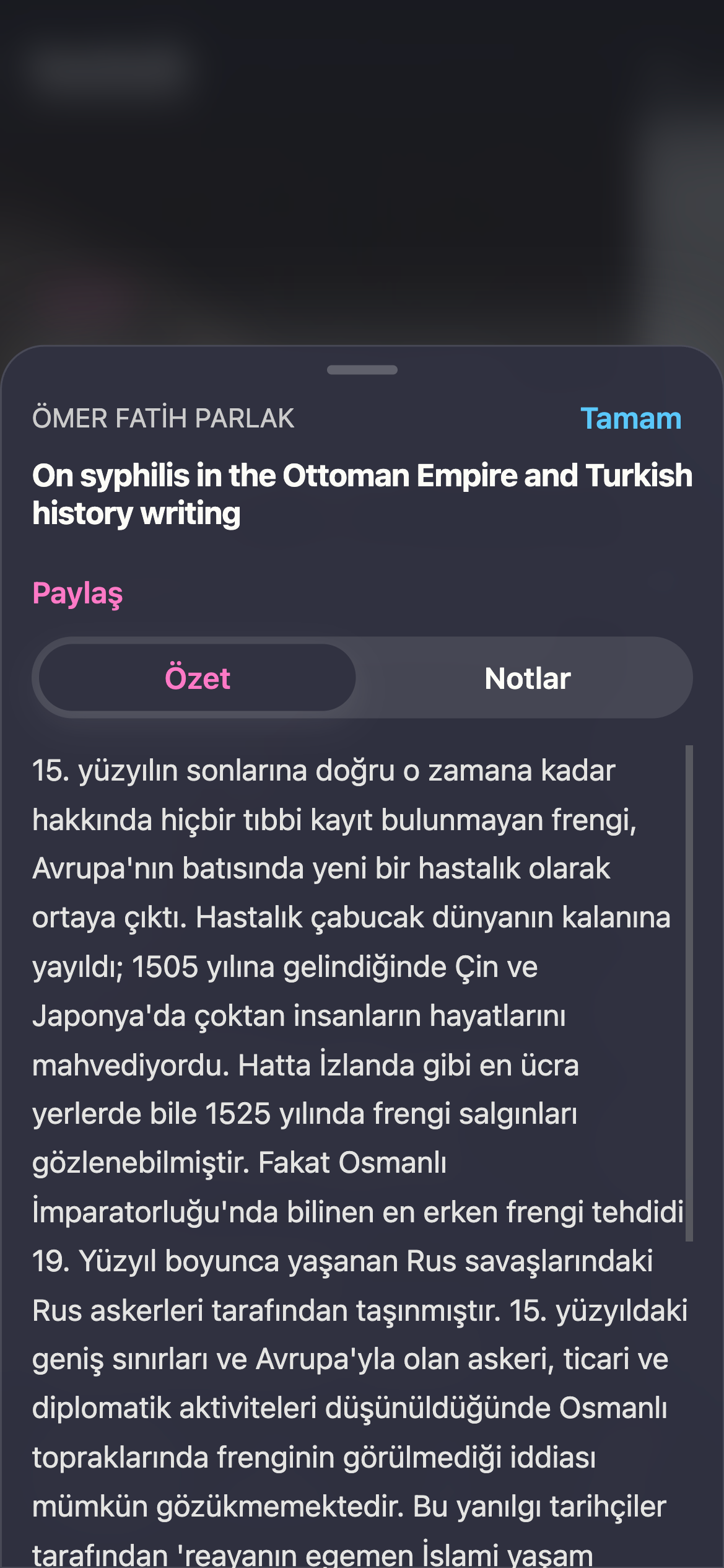
Abstract panel

Full abstracts & papers

Tap "Read abstract" to reveal the full text in a bottom sheet. Tap the document icon to open the original paper in a browser.

  • Full abstract in a bottom sheet
  • Open source PDF in browser
  • Author names always accessible
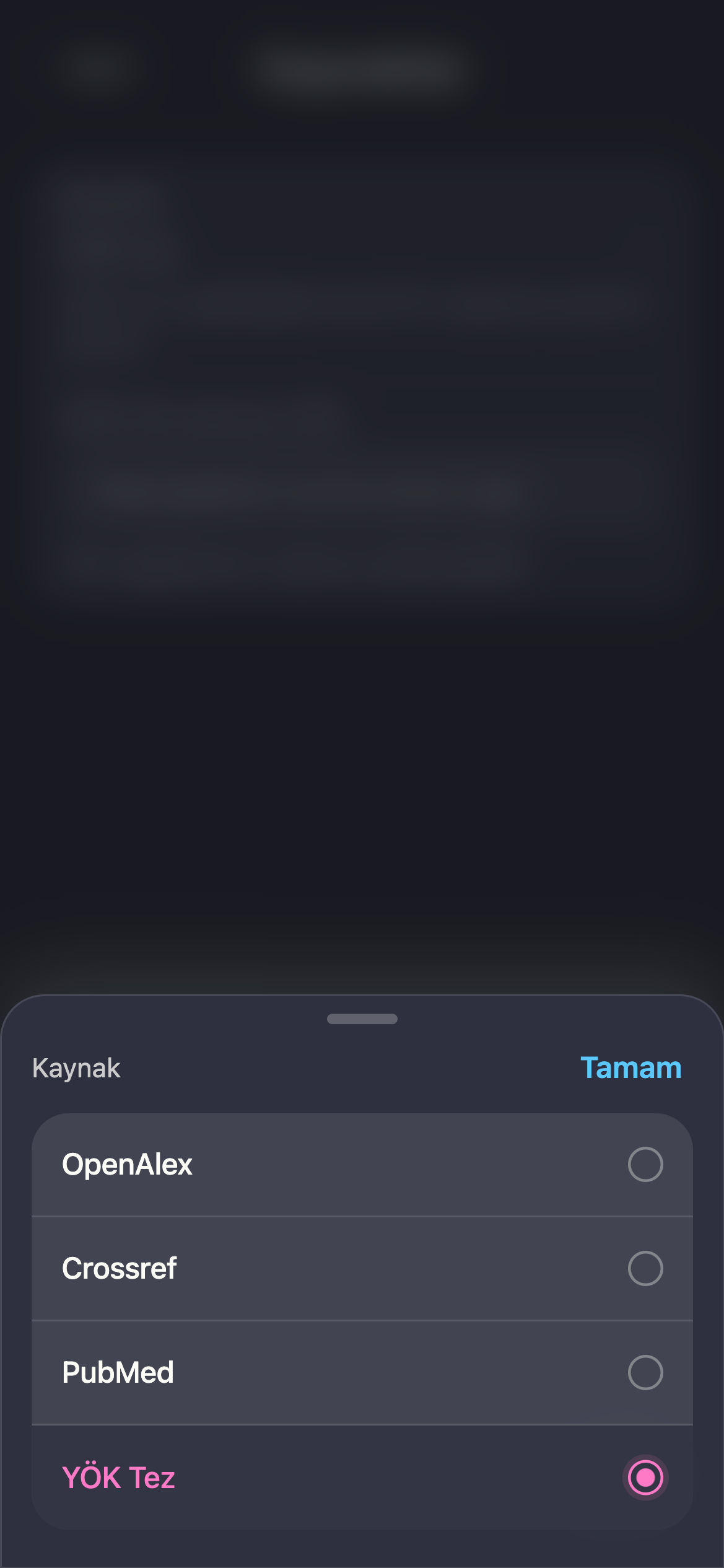
Source selector

Choose your source

Switch between OpenAlex, Semantic Scholar, CORE, or Crossref from Settings. Each provider surfaces different research.

  • 5 open-access academic providers
  • No account needed
  • YÖKTez via backend for Turkish theses

Open-access APIs,
unified in one feed

Rather than scraping a single database, TezTok integrates six open-access APIs — enabling cross-domain discovery across disciplines.

YÖK
YÖKTez Turkish national thesis database Back-end scraper server needed
OA
OpenAlex 250M+ scholarly works, fully open and free
SS
Semantic Scholar Academic search by the Allen Institute for AI API key needed
CO
CORE Largest open-access research aggregator API key needed
CR
Crossref 100M+ DOI-linked scholarly metadata records

Why this matters

The problem is not access — it's discovery. Most academic databases are built for targeted search, not for passive exposure to new ideas.

The problem

  • Academic databases (PubMed, JSTOR, Google Scholar) optimise for known-item search, not serendipitous discovery.
  • Casual exposure to research outside one's immediate field is structurally low for non-specialists.
  • Dense abstracts create a front-loaded cognitive barrier that discourages exploratory reading.

The hypothesis

  • Short-form interaction patterns (vertical swipe, progressive disclosure) may reduce the perceived entry cost of engaging with academic content.
  • Aggregating multiple open-access APIs into one feed may broaden cross-disciplinary exposure compared to single-source browsing.

Research framing

  • Domain: Human–Computer Interaction, Information Systems, EdTech
  • Design pattern studied: Progressive disclosure + snap-scroll applied to long-form content
  • Key open question: Does interface familiarity (social-media-like UX) transfer to willingness to engage with unfamiliar academic domains?

Explore the project

Free, open-source, and runs on any device. Clone the repo to run it locally.

Built with React · Vite · Express · Capacitor